PROJECT OBJECTIVE
To translate the pavilion’s vision into a clear and accessible secondary narrative and accessible wayfinding.
CLIENT
Department of Business and Trade (UK GOV) & Osaka EXPO 2025
LAUNCH YEAR
2025
LOCATION
Osaka, Japan
OVERVIEW
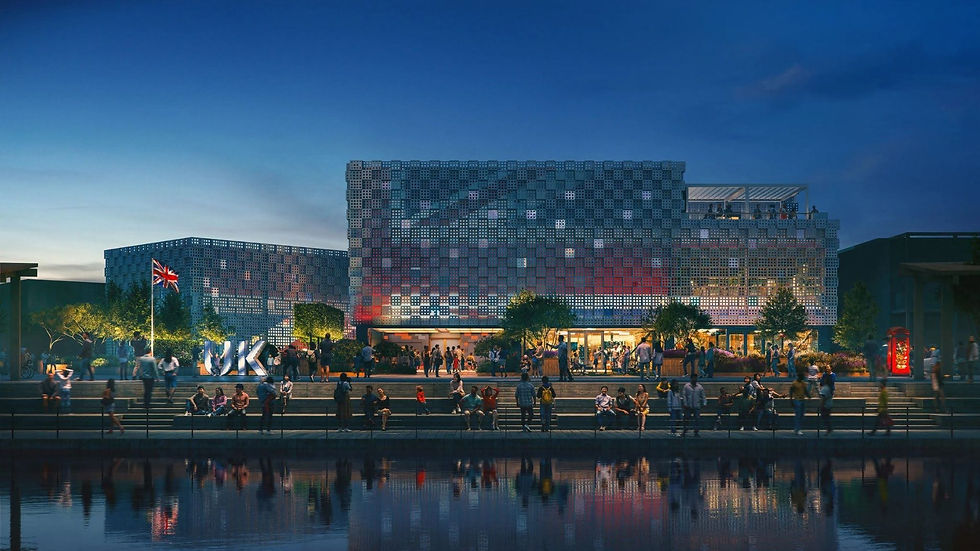
The UK Pavilion at Expo 2025 Osaka was a two-year international project designed to promote the UK as a global leader in innovation, creativity, and future-focused thinking. Built around the theme “Come Build the Future”, the pavilion delivered a story-led, immersive experience for Japanese and international audiences, combining spatial design, narrative, animation, and brand expression. As an Integrated Designer, I contributed across the full lifecycle of the project, from early concept development through to delivery. During the initial brand phase, I helped define the pavilion’s look and feel, supporting a visual identity that paired a Union Jack–derived colour palette with a blocky, 8-bit–inspired visual language. The pixel aesthetic was developed as a cultural bridge, referencing the origins of early digital and gaming culture in Japan, while maintaining a distinctly British tone through colour, composition, and restraint. My primary focus was the design of the secondary narrative, creating large-format exhibition graphics that supported and expanded the core story across each gallery space. I worked closely with spatial and lighting designers to define where and how secondary print media would sit within each environment, ensuring narrative clarity, legibility, and integration within the wider spatial experience. Alongside this, I supported early visitor flow research, helped establish an initial wayfinding system, and contributed to the design of an accessible wayfinding strategy that prioritised inclusivity and ease of navigation. I also collaborated on elements of the primary narrative, particularly through character development and storyboard design for animated content, helping translate complex ideas of UK innovation into engaging, human-centred stories.

The visual guide set the foundations of the UK Pavilion’s design system, bringing together colour, typography, iconography, and content style to define a cohesive and flexible look and feel for the experience.
Alongside this, some of my process focused on translating that visual language into space, exploring how graphics, light, and character-led elements could work together, and refining ideas from early concepts through to production-ready outcomes.
1/4 PROJECT DEVELOPMENT


A stitched 30-second fly-through presentation used to map the pavilion journey from start to finish, helping visualise how the primary and secondary narratives work together across each of the acts of the experience.

Photography capturing the supporting narrative as experienced in the pavilion, documenting large-format printed graphics, moments from the PIX character narrative, and the wider secondary narrative during the Duke and Duchess of Edinburgh’s visit.
2/4 Supporting Narrative: Large-Format Print Experience


ImmersiveInternational_1688B.jpg)


The accessible wayfinding panel was designed in collaboration with the Royal National Institute of Blind People, presented as a single 1.5m by 0.7m panel combining English and Japanese text with their respective Braille translations, developed in line with accessibility standards of the UK and Japan.

3/4 accessible wayfinding

Supporting this, I also designed two types of wayfinding booklets: a Braille edition recreating key wall graphics, a map of the UK, and a map of the pavilion in raised form for blind visitors, and large-print A4 booklets using simplified layouts and typography to support visitors with reduced vision.


